Is the student already proficient in another language?
What is the student's cultural background?
Should ELL students be taught contracted or uncontracted braille?
Is it better to teach a student braille in her native language or to introduce American braille right away?
There is no single answer to this question. It will depend on factors such as:
- the student's age
- command of English
- reading level in native language
- other learning difficulties
How can we address so many different needs when a student is blind and also an English Language Learner?
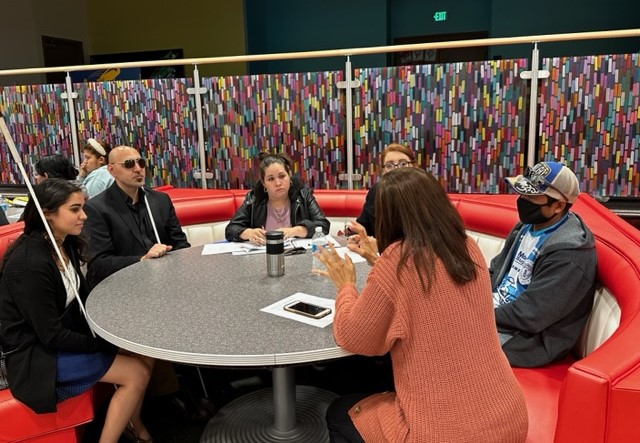
It is especially important to work closely as a team when there are so many different specialists involved. For a student who is an English Language Learner with a visual impairment, there may be a TVI (Teacher of the Blind and Visually Impaired), a Teacher of English as a Foreign Language, a reading specialist, a special education teacher, and a general education teacher all participating on the educational team.
Points to remember:
- The child is a child first! A student who is an English Language Learner and who also happens to be blind or visually impaired will have most likely have complex educational needs.
- Someone needs to be monitoring progress. If the student is not making progress, it is essential that all members of the team meet to plan a more effective program that meets his or her individual needs.
-
There should be a primary case manager or person who is responsible for coordinating the pieces of the student's program. This person should pull the team together on a regular basis and be sure that there is good communication among all people working with the child.
Are children who are deaf considered to be English Language Learners?
Some children with deafblindness are fluent in American Sign Language (ASL) and this is considered to be their first language. ASL is a different language from English and, thus, materials in English should be at the appropriate level for the student.
For more information, see ASL/English Bilingual Programming and Early Childhood Education from The Laurent Clerc National Deaf Education Center at Gallaudet University.
Is braille the same in all different languages?
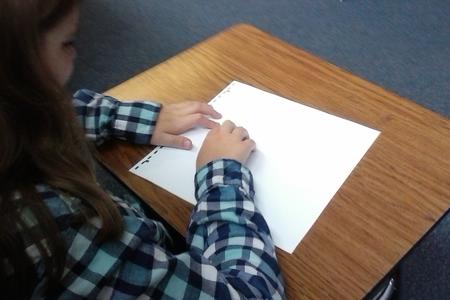
Braille is a code, not a language, and each language has its own set of rules for braille.
To see a sample of symbols in Spanish braille, see Foreign Language Braille, from American Foundation for the Blind.
For additional information, see Transcribing Braille Documents in Foreign Languages from Mobility International USA, which has the following sections:
- Braille Overview
- Languages in the Latin Alphabet
- Languages Not Using the Latin Alphabet
- Print to Braille Conversion
- Print to Braille Software Programs Developed Abroad
- Location of Instruction: What are the Rules?
- Converting Foreign Language Braille into Print
What issues are important when teaching students of multi-cultural backgrounds?
It is important to teach all students with understanding and respect, and this is especially important when working with students of diverse backgrounds. Personnel Preparation programs should seek to include sensitivity and awareness to multicultural issues in the training of teachers.
For more information, see:
Journal of Visual Impairment and Blindness: Special Issue on Cultural Diversity and Visual Impairment, Vol. 93, No. 5 (May 1999).
Milian, M. & Erin, J. N. (Eds.). (2001) Diversity and visual impairment: The influence of race, gender, religion, and ethnicity on the individual. New York: AFB Press.


The Call for Papers for Getting in Touch with Literacy has been extended to May 22, 2013.