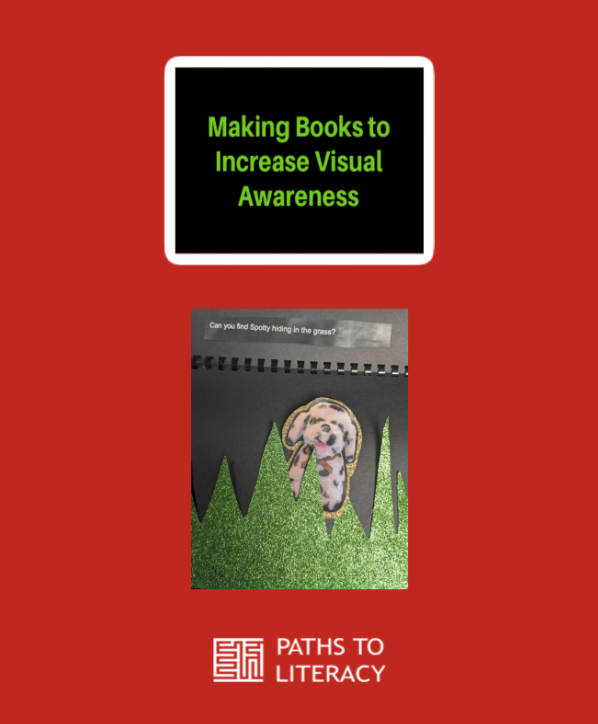
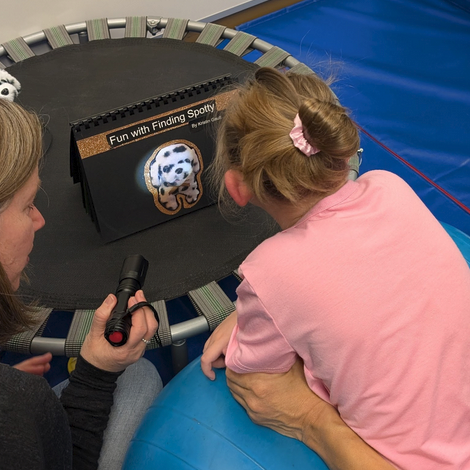
Every year our team tries to try incorporate something new in our approach in working with our students with CVI (Cerebral/Cortical vision impairment), a brain-based visual impairment. Motivation is critical when encouraging a student to use their vision. Paying attention to what a child is interested in and incorporating that interest plays a big part in this motivation piece.
This last year I coupled this motivation with literature through an idea I got from APH’s book Where is Little Fuzzy? I love the concept of the book, however it did not hold the interest of my students, and therefore did not hold the effort needed to use one’s vision.
I like to focus on taking the students’ lead to notice how they explore each page.
- What are they exploring most?
- Where are they looking or touching?
Ask questions to see if they can explore certain visual and tactile attributes. For example, find the green grass or touch the fur.
- What are they doing when prompted?
- Where do they touch?
- The right side of the grass?
- The head of the dog?
Taking the lead of your students to better understand how they are perceiving and making sense of their learning materials is key. And even when moving to 2D, continuing to add a tactile element to support recognition. Many with CVI use both visual and non-visual skills to recognize items. The goal is always access to learning.
Depending on the ability of the student to find these features within a background, the visual clutter can be either increased or decreased within each page. This makes the book interactive and adaptable.
As part of our state’s CVI team, I shared what I had done and was encouraged to share with all Oregon TVIs as we strive for collaboration. Receiving good feedback, I thought it would be good to share here as well. The following is what I came up with instead, a book idea that I have used with several students this last year with great success. I encourage you to look through each slide a better understanding.
Here are some examples:
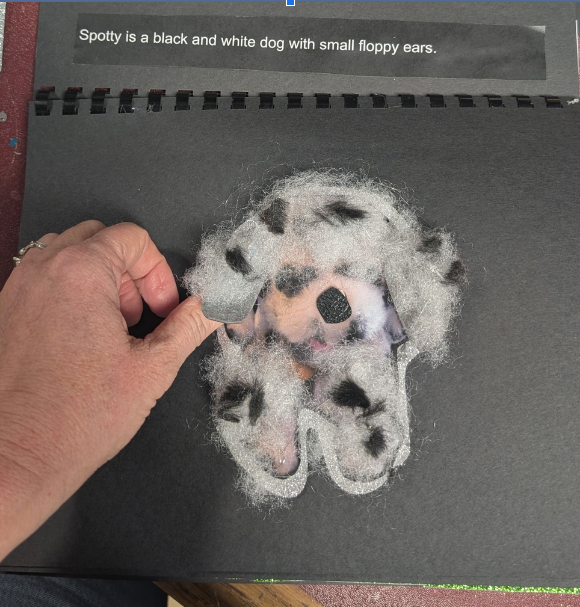
Spotty is a black and white dog with small floppy ears.
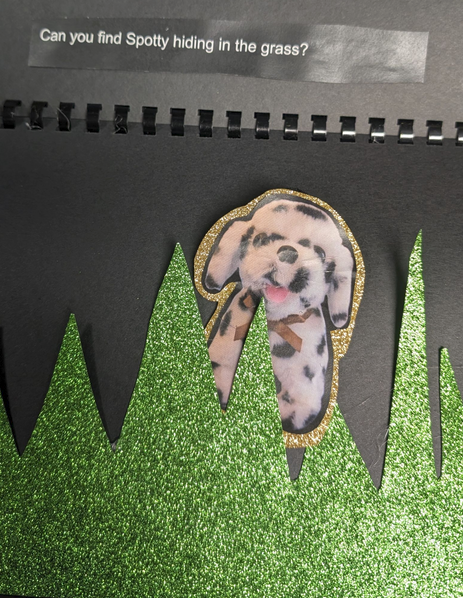
Can you find Spotty in the grass?
Here is a copy of the complete slides for you to get inspiration from to use with your own students.