“Fall comes with different colors to challenge a green Summer”
Neamat Alishiryan
The book I selected for this month was Tree Full of Wonder: An educational, rhyming book about magic of trees for children by Anna Smithers.
The book description:
“Tree Full of Wonder is a vibrant, rhyming, educational and unique picture book showing the unbreakable bond between people and trees. For children ages 3-8. Kids will fall in love with nature and will become Protectors of the Trees.”
A side activity to keep working on their cutting and gluing skills was the Fall Leaves Cut and Paste Printable Book. This allowed me to work on organization of the book for assembly purposes. The students had to decide if they wanted their books laminated, bound by staples/binder rings/brads or use binder combs. Students’ wishes weigh a lot with me and I try to honor them where I can.
The skills worked on this month are many. Here’s but a few:
- Book knowledge (i.e., title, author, page turning, image walking)
- Use of low vision tools while reading the book
- Develop hand and eye coordination
- Soliciting assistance appropriately
- Fine motor
- Communication
- Positional concepts
- Choice making


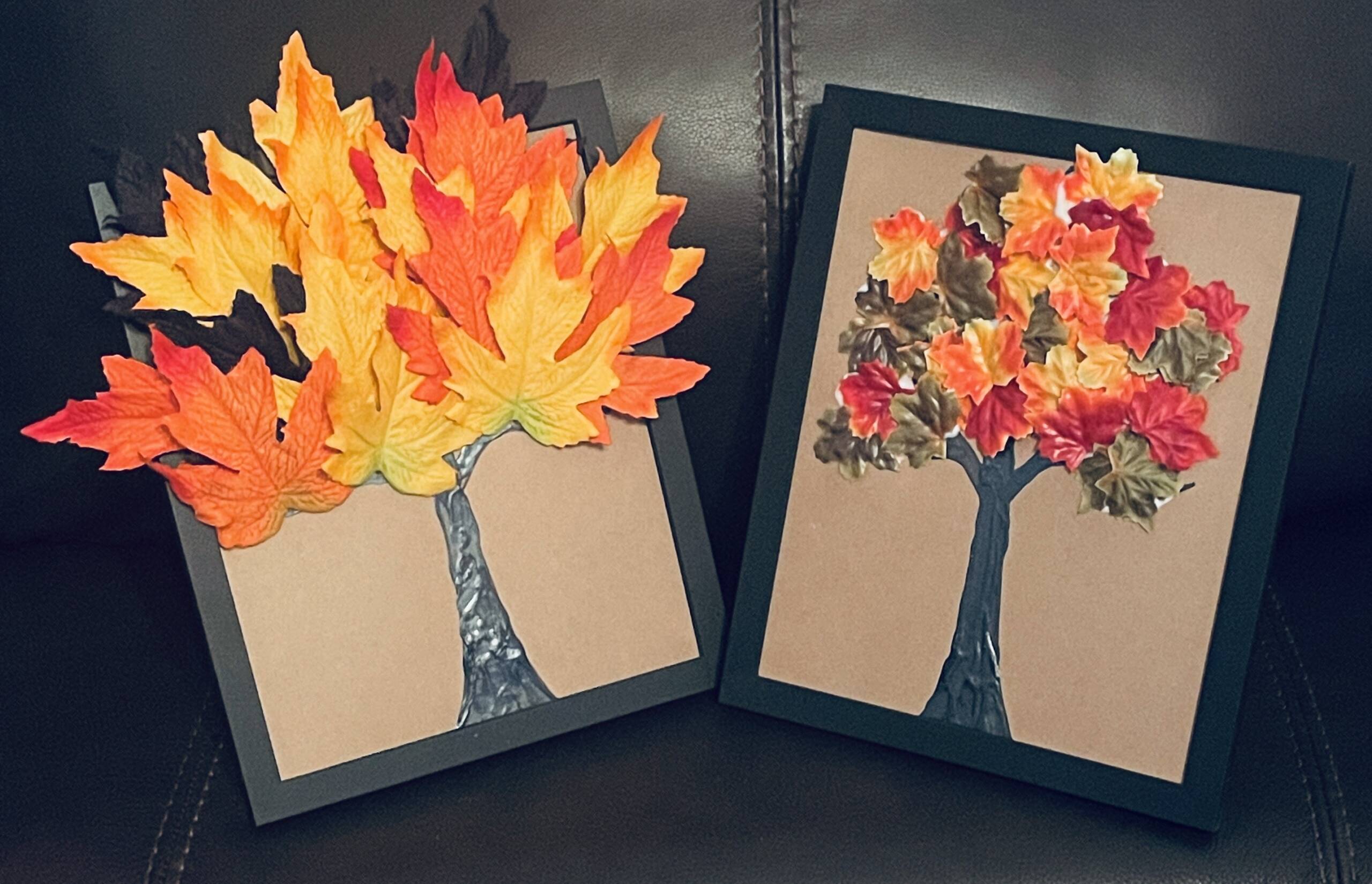
A friend of mine found this idea on Facebook a year ago and sent it to me thinking I might be able to do something with my students using this idea. Well, she was right! This is a great craft to partner with the occupational therapist on! I was able to discuss which students I needed to adapt the activity for, recommendations for material placement, and to co-treat with them.
For this craft, I needed:
- Outline of a barren tree (unless you can free hand draw one)
- Liquid glue
- Chipboard Sheets (or heavy weight cardboard)
- Autumn Maple Leaf Artificial Leaves (for poking in the cardboard)
- Red & Orange Fall Leaves Confetti (can be found at a craft store)
- Glue
- Puff Paint/T-shirt paint
- 8×10 Picture Frame Black
- Dremel
- Packing tape
Prep work took some time. I needed to find a barren tree image and then printing it on card stock. After trimming it out, the image needs to be traced on the chipboard sheets. Using puffy paint, paint the tree image. I gave the trees 24 hours to dry. Once dry, I used a Dremel to drill holes in the chipboard where the branches are approximately 1 ½ inches apart.
The next step depended on the student. If the student is able to put a leaf in a drilled hole, the larger leaves were needed and they chose which ones to put in. Once all the leaves are put in, carefully turn the chipboard over and use the packing tape to secure the leaf stem to the chipboard.

If the student is unable to do this, then the student works on putting glue on the upper part of the tree. Once the top has a “generous” amount of glue, the student can either place the leaves down on top of the glue, or sprinkle the leaves.
This was a two-day craft for the students using glue as the glue needed to dry before we could continue. The students then take their finished trees to put in the picture frame. Here they were able to practice soliciting assistance appropriately if needed. Before putting on the back of the picture frame, the students either wrote their name or used a name stamp to put their name on it.
Recipe for Puffy Paint (cornstarch-based)
Ingredients:
- Cornstarch
- Water
- Food coloring (optional)
Instructions:
- Mix about 1 cup of water with 1 tablespoon of cornstarch in a microwave-safe container.
- Microwave for 15 seconds, then stir.
- Repeat microwaving and stirring in 15-second increments until the mixture thickens considerably.
- Add food coloring to the thickened mixture to make it paintable.

Tips
- Have a student that doesn’t like touching glue? I use disposable vinyl gloves on the hand that is holding the item in place while the hand that is using the glue does not.
- When looking for a good image to use for the tree, try doing a search for the image you want as a color page. This has opened up much clearer images to use.
- Use parchment paper between the barren tree images to prevent sticking.
- Depending on the larger sized leaves bought, you may need to trim the very tip of the leaf as it may not fit in the drilled hole.
- Start a document with ideas for each month for the next year so you’re not scrambling for ideas each month.
Extension Activities
- Create a sensory tub with the leaves and put in acorns, miniature pumpkins/gourds, etc. The students can sort the items into small tubs and then count the items. Perhaps even make a graph of their findings.
- Using paper leaves, have the students write something they are thankful for and either tape it to the back of the frame or hang it in the classroom with other students’ leaves.
- Make the puffy paint with students. They can work on measuring, mixing, etc. as well as microwave safety.