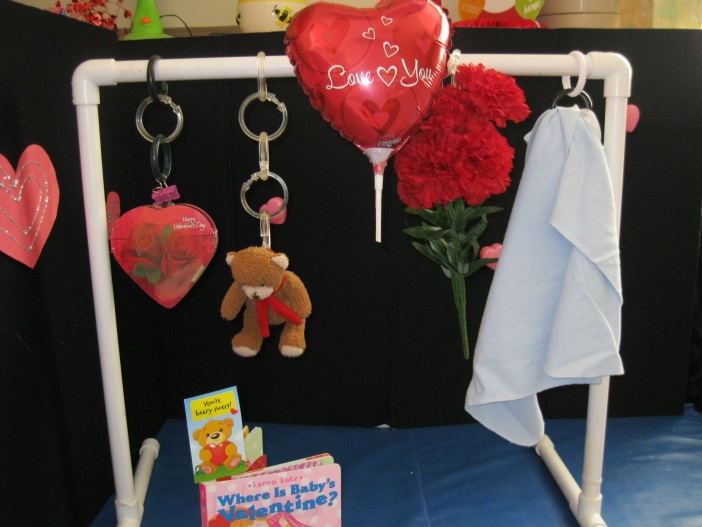
Toy bars are a wonderful tool when teaching pre-literacy skills. Object awareness and knowledge can be introduced and reinforced through toy bars. Students learn about the characteristics of items through all of their learning channels. They have repeated opportunities to explore the objects. Toybars allow students with limited movements observe and explore the objects. All of their materials are placed within arm’s reach, and when appropriate, within their visual field. This encourages initiative and independence.

What is a Toy Bar?
A toy bar is a frame with selected objects suspended on it and positioned to hang in front of a child. They can be placed on a wheelchair tray, a desk, or on the floor, if a child is lying down.

Toybars can be divided into different categories:
- Seasonal
- Holiday
- Environmental
- Sports
- Dress Up
- Color
- Shapes
- Stories
- Textures
How to Make a Toy Bar:
To build a great toy bar you need the appropriate materials. They can be made of PVC pipe or any sturdy material. Toy bars can be various heights for adapted seating and for wheelchairs. It is sometimes helpful to spray paint to bars black or white. Hang the items from the shower curtain rings and or the elastic. Be sure to space out the items. Limit the number of items to 5 to 6. You can use two toy bars if necessary to place hang all of the storybox items, rather than trying to crowd them all on one bar. See Instructions to Make a Toy Bar.
Components of a Toy Bar:
- Shower curtain rings
- Elastic
- Everyday items
- Toys
- Instruments
- Beads
- Pom poms
- Boas
- Garland
Places to purchase/locate toy bar items:
- Dollar stores
- Walgreens
- CVS
- Target’s Dollar Spot and Birthday aisle
- Home
- Classroom
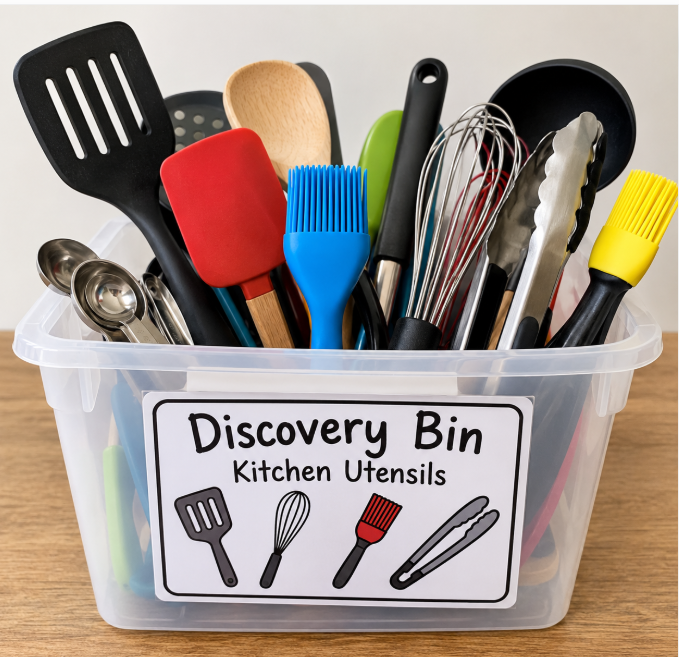
Organization is also key. To help keep my classroom toy bar items organized, they toys are sorted by color in baskets. Storyboxes are also kept sorted in boxes and baskets in boxes for easy access.

For children with CVI (Cerebral/Cortical Visual Impairment), it is sometimes preferable to keep the toy bars the same color and to use reflective materials. Red, yellow and green toy bars are favorites.
Red Toy Bar:
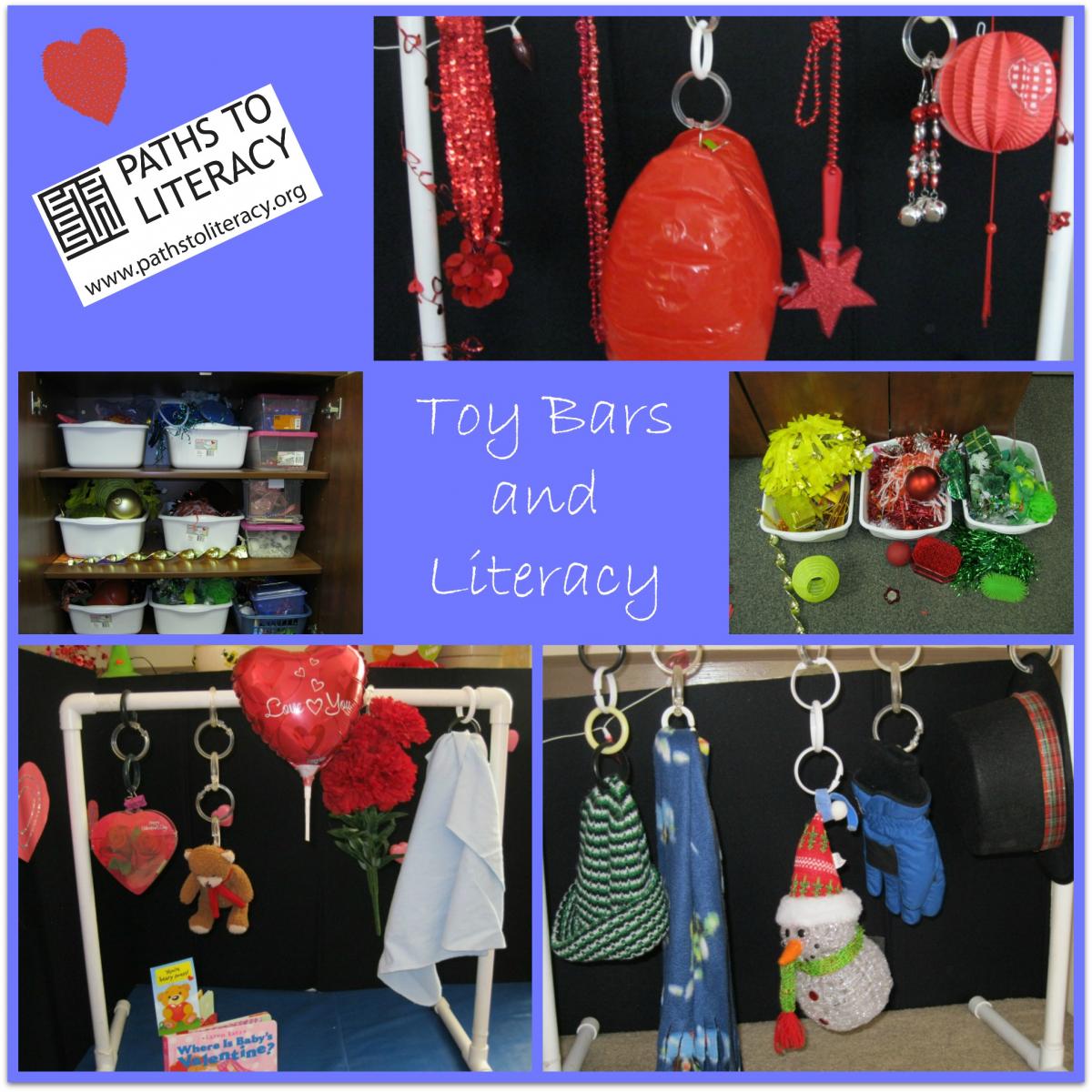
 This toy bar has items on it from the red toybar. I added the large heart and the paper lantern. There is also red sparkly garland wrapped around the entire toy bar. This helped my students with CVI transition from a red toy bar to a holiday toy bar, without becoming overwhelmed with too many new items.
Texture toy bars can be crinkly, soft, bumpy and smooth. Shape toys bars can be initially used to introduce a shape. As a student becomes familiar with a shape, you can present two or three shapes on a toy bar.
Storyboxes and Toy Bars:
Toy bars can be used in connection with the storybox or as part of the storybox. Hang the items on the toy bar. Encourage your student to explore the new toybar. When appropriate, provide hand under hand assistance and verbal descriptions. After the student has had sufficient time to become familiar with the items, (which may be days or over a week or two), read the story with student. As the items as mentioned, highlight the item. Allow the student time again to visually or tactually respond to the item, touch and explore. Together, the teacher and the student can use the item (such as wearing beads, watering a plant, playing an instrument). Take the item off the toy bar and hand it to your student so s/he may develop knowledge of the whole item.
Occasionally, some students enjoy listening to the story on a CD or IPAD while playing with their toys. Young children typically enjoy listening to a story again and again. I typically work with a story and storybox for a minimum of one week and often for two weeks. If a student is particularly interested in a story, I will keep it available for a month.
Storybox Toy Bar Items:
Next week we will read the book Where is Baby’s Valentine by Karen Katz .
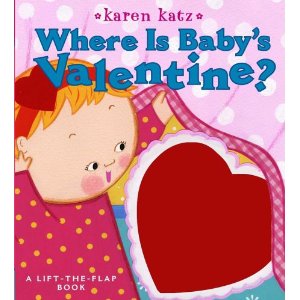

The book addresses real items and positional concepts. I replace the name Baby with the student’s name. The items are hung from the toy bar. They are easily removed so the student can hold the items. To make a complete storybox or toybar the following items are needed: chair, balloon, blanket, bear, lamp, flowers, pillow, box of chocolate, cupboard (this one is harder to find) cookies and a valentine.
Ideas for Other Story Boxes:
We made a class book about the clothes a snowman wears. To accompany the book I created this Snowman’s clothes toybar. I also hung a toy snowman that lights up.