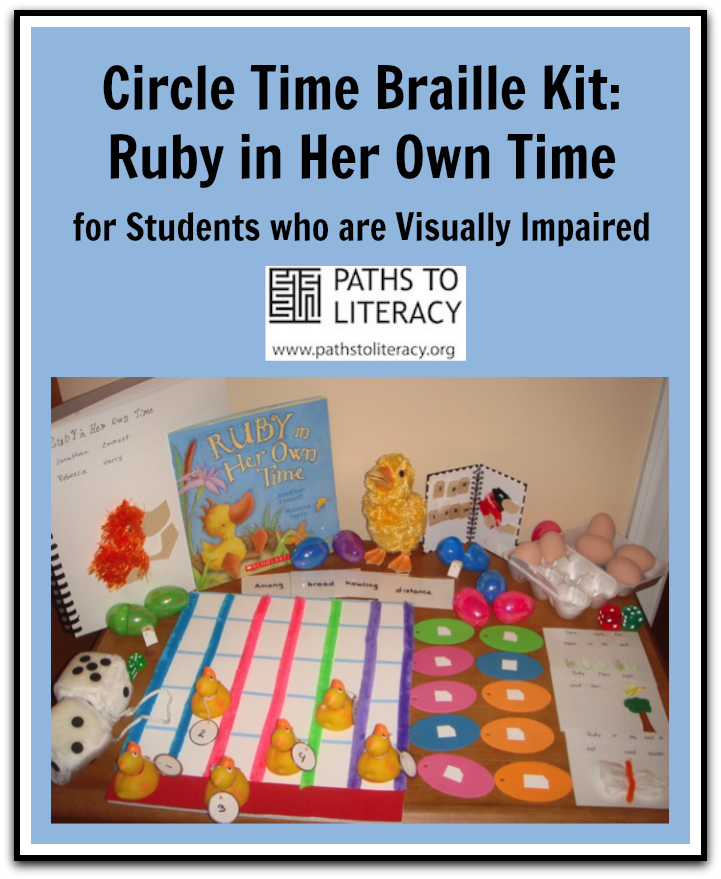
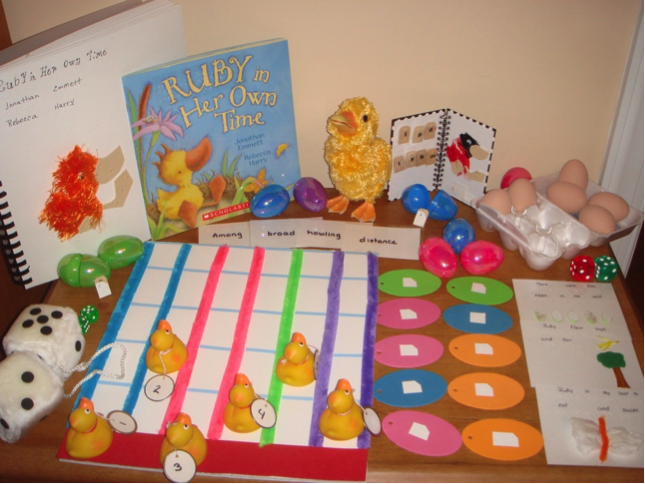
Ruby in Her Own Time is a Circle Time Braille kit focusing on counting skills and duck Fun Facts. This kit is based on the book Ruby in Her Own Time written by Jonathan Emmett and illustrated by Rebecca Harry (Scholastic rates the book K-2.)
Please see the tactile version of this book: http://www.pathstoliteracy.org/strategies/ruby-her-own-time
This Circle Time Braille Kit Contains:
Tactile Books:
- Illustrated print book with Grade II or contracted braille added
- Print/braille/tactile book (with uncontracted or Grade I braille)
Songs:
- 5 Little Ducks
- 6 Little Ducks That I Once Knew
- Little Ducklings Poem (act out actions)
- Peck Peck Peck Poem (written by Aileen Fisher)
Objects:
- Realistic toy duckling
- Egg Count: 6 Eggs/carton/6 small rubber ducks
- Braille Number Egg Game: (6 eggs/carton/dice)
- Duck Race: 6 Small rubber ducks/dice/ game board (small regular dice and large fuzzy dice)
- Egg Hunt Number Hunt: foam ovals each with one braille letter
- Quacking Egg Hunt: egg(s)
- Crack The Code Egg: Plastic Easter Eggs/brailled numbers
- Vocabulary Words- laminated braille index cards
- Sequence Cards – laminate/tactile braille index cards
- Word Tree Book: small spiral notebook; creating braille rhyming words with “-uck”
*Some objects will be used in more than one activity
Computer Games:
Games are no longer available; however, you can re-create these “games” on an iPad/accessible tablet.
- Ruby in Her Own Time Fun Facts (multiple choice)
- Ruby in Her Own Time Vocabulary Words (multiple choice)
For additional ideas, YouTube videos, etc, do an Internet Search. Pinterest has a whole board on Ruby in Her own Time
Teacher Hints – Before the student reads the story:
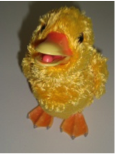
Define and describe the various parts of a duck using the realistic duck model. Encourage your student to explore the duck. Caution! When the duck’s tongue is pressed, the duck will quack and move its wings! As the student touches various parts of the duck, explain (on his/her level) what each part is and what that part does. If appropriate, use the Duck Vocabulary Words when exploring the model duck. The Duck Fun Facts will help explain the parts of the duck.
Introduce the Vocabulary Words with the student (Use brailled index cards; see “vocabulary words” under Activities listed below). When reading/listening to the story, ask the student to clap each time he/she comes to a vocabulary word. Be sure to prompt the student if he/she misses a vocabulary word in the story. There are additional Duck Vocabulary Words that are not in the story. The Duck Fun Facts are more challenging and may not be appropriate for younger students. These Fun Facts words are used in the Fun Fact computer game.
When teaching a beginning braille reader, re-read the book multiple days in a row. Depending on the student’s current reading abilities, the first day the teacher may read the book, asking the student to follow along filling in a familiar word here and there. Ruby In Her Own Time does not have repetitive phrases, rhyming words, or other techniques that help a student easily anticipate the words in the story; therefore, if the student is not currently reading sentences, emphasize comprehension and other reading techniques more than decoding each word. This story is a great read-aloud circle time story (where the teacher reads the book). Read the story together multiple days in a row, encouraging the student to follow along (if appropriate) and to find specific repetitive words (such as Ruby or duck) and if possible, to read parts of the page as he becomes more familiar with the story and anticipates the words. Repetitive reading encourages many pre-reading skills and comprehension as well as giving the student opportunities for success!
This story is intended to be read to the student; however, reading the book may be appropriate for an older or more advanced student who is working on reading skills such as fluency, speed, comprehension, decoding, etc.
Predict Question: There is a felt star on the top right hand corner in the print/braille/tactile book. When on this page, the teacher should stop and ask the “prediction” question. General prompt, “What do you think is going to happen?” If the student needs a specific prompt, “Ruby flies fly off into the distance. What do you think she will do next?”
Transcribers Note: Grade II Braille in the illustrated/print/braille book corresponds with the print. Grade I Braille is used in the print/braille/tactile book. The tactile illustrations in Ruby in Her Own Time are created to be as realistic as possible and to demonstrate additional concepts, such as having wings that move to indicate how a duck flies. Discuss the tactile illustrations and how fragile these particular illustrations are prior to allowing the student to explore them.
Story Repetition: In this story, the Father Duck asks if Ruby will ever ____ (hatch, eat, swim, etc.) and the Mother Duck always answers, “She will in her own time.” Encourage the student to chant, “She will in her own time.” The very last question, the Mother Duck asks if Ruby will she ever come back and the Father Duck replies, “She will in her own time.” Discuss how the Mother Duck always believes in Ruby. (This is a great way to lead into the journal prompt.)
Activities:
Vocabulary Words:
Introduce vocabulary words prior to reading the story!
- Howling- a long, loud, sad sound
- Broad-wide from side to side
- Among-in the middle, surrounded
- Distance-far away
*When reading/listening to the story, ask the student to clap each time he/she comes to a vocabulary word. Be sure to prompt the student if he/she misses a vocabulary word in the story!
Duck Vocabulary Words:
(These duck words are more challenging and may not be appropriate for your student; these concepts are NOT part of the story.)
- Waddle – rock from side to side
- Bill – a duck’s mouth
- Drake – a male duck
- Hen – a female duck
- Duckling – a baby duck
- Spoil – turning bad, rotten, smelly
- Clumsy – awkward, tripping
- Float – to stay above water; not to sink
- Oval – almost round in shape (egg)
Duck Fun Facts
- Duck’s Bill – The duck’s mouth is called a beak or bill. It is usually broad and flat and has rows of fine notches along the edge. These notches help the duck to grip its food so that it will not slip off.
- Duck’s Feet – Ducks have webbed feet, which are designed for swimming. Their webbed feet act like paddles for the ducks. Because their feet are webbed, they tend to “waddle” instead of walking straight. Ducks cannot feel the cold in their feet even when swimming in icy cold water. Their feet do not have nerves or blood vessels to feel the cold. The webbed feet are powerful, allowing the duck to swim fast.
- *Teach the student to “waddle like a duck” (do not bend the knees, toes out; tuck the thumbs under the armpit and flap (to make wings) and quack!
Easy Duck Fun Facts:
- Ducks are water birds.
- Ducks love to swim.
- Ducks waddle when walking on land.
- Duck feet are webbed and are far apart which helps them swim.
- Ducks can swim, walk and fly.
- Ducks live in nests by the edge of the water.
- Baby ducks hatch with their eyes open and can walk and swim right away.
- Ducks have feathers that are waterproof and keep them warm.
- The duck’s mouth is called a bill. Bills are flat and rounded.
- Ducks quack.
- Female ducks are called “hens” and males are called “drakes”.
- Duck eggs are shaped like an oval.
- Ducks eat grass, plants, pond weeds, water snails and some insects.
Sequence Cards:
(Laminated, brailled index cards with tactile illustrations)
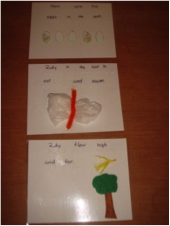
- Introduce the sequence cards after reading the story
- Students place three tactile/brailled sequence cards in order of the story.
- 1. There were five eggs in the nest. (tactile egg in nest)
- 2. Ruby is the last to eat and swim. (tactile baby duck on water)
- 3. Ruby flew far and high. (tactile duck flying above water)
Who, Did What, When, Where and Why?:
Comprehension game (currently teacher questions; will be a computer game); Teacher chooses which “W” questions to ask (may only use Who did What?):
- After reading the story, ask the student:
- Who? (Who was in the story? – naming Ruby, Rory, Rufus, Rosie and Rebecca; Mother Duck and Father Duck)
- Did What? (What happened in the story? Baby ducks wandered off for a swim – Ruby was always behind looking at things, storm came up and ducks were lost; Ruby found her way home because she remembered the things along the way)
- When? (When did the ducks start their swim? Swimming on a nice day and then the storm came) and
- Where? (Where were the baby ducks? swimming in the pond and then home to the nest) and
- Why? (Why was Ruby able to find the way back? Because Ruby paid attention to things along her route and was able to figure out the route home.)
Word Tree Book:
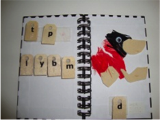
(Small spiral notebook with rhyming “–uck” word family.) Student moves each Velcro letter from the left side of the page to the Velcro in front of the “-uck” to create a new rhyming word (tuck, puck, duck, luck, yuck, buck, muck) Be sure to show the student that the braille is on the bottom of the wooden tiles and the top of wooden tile is slightly rounded.
- Egg Count: (Rubber ducks numbered 1-6, eggs and egg carton) Tell the student to pick a duck from the duck pond. Have the student read the braille number on the duck (or read it to him). The student will count and place the same number of eggs in the “nest” (egg carton). (Ex: If the student picked the duck with the #4, then he will place four eggs in the carton.) Repeat choosing another numbered duck.
- *Modifications: Substitute one die for the numbered Rubber Ducks. Ask the student to roll the die, determine the number and place the equivalent number of eggs in the egg carton. For more advanced students, numbers can be brailled on index cards; simple addition or subtraction facts (with answers up to 6) can also be brailled on index cards and substituted.
- *If appropriate, have the student name the corresponding braille number positions (dots 1-6) as the eggs are removed from the egg carton.
- *Student can places eggs in the carton in various ways in order to make different braille letters. Example: See how many letters can be made with two eggs: “b”, “c”, “e”, “i”, etc.
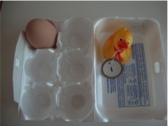
- Rubber Duck Race: (dice, 6 rubber ducks, and game board)
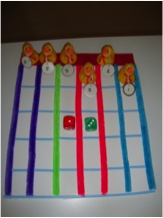
- Line the ducks up on the foam strip in order of their attached numbers. Use either the large fuzzy dice or the regular dice. (The fuzzy dice are easier to count the numbers and typically do not roll very far.) Roll the dice. Move the corresponding numbered duck one space. (If 3 and 4 come up on the dice, then duck numbers three and four will both move forward one spot.) Each duck will stay in his own lane (between the fuzzy lines) and will move only one space at a time. Students can take turns rolling the dice and counting the numbers. If both die have the same number, the duck will move forward two squares. The first duck to cross the finish line is the winner. Each person should choose a duck to cheer to the finish line!
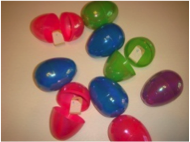
Crack the Egg Code: (Plastic Easter Eggs, brailled numbers 1-9)
*Teach that the rounded edge of the wooden tile is on top. The braille number has a notch on the upper right hand corner.
Place a brailled number inside each Easter Egg. Tell the student to pick and egg and “crack” it open, and then read the number.
- Braille Number Egg Game: (Ceramic Eggs, egg carton, dice)
- Review the egg carton number positions (dots 1 – 6). The teacher can call out a letter and the student can create that letter by placing the eggs in the corresponding egg carton holes. The teacher can call out the numbers and the student can place the eggs and name the letter. The teacher can place the eggs and ask the student to identify the numbers/letter. The student can switch and be the “teacher”.
- Modification: Roll two dice. Place an egg in the corresponding carton slot. (Example: Dice rolled #1 and #3, place an egg in the corresponding braille dot 1 position and braille dot 3 position in the egg carton.) Name the braille letter (dot 1 and dot 3 creates the letter “k”). If you roll doubles, then you lose your turn and the next student (or teacher) takes a turn. Continue to roll one dice and add the next egg to create a new letter. If the same number comes up again, you lose your turn. Whoever rolls all six numbers without duplicating a number wins. (Or whoever rolls the most times in a round, wins the round.) You must name the created letter correctly or you lose a turn.
- *Can roll the dice and put egg in that position. Can roll two dice and put two eggs in the carton and see if it makes a letter. If not, can the student figure out how to make a letter by adding another egg?
- *Braille number/ letter on each index card and have student “make” the braille number/letter by placing eggs correctly in the carton.
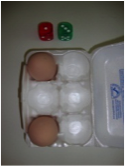
- Quacking Egg Hunt: (Egg or eggs)
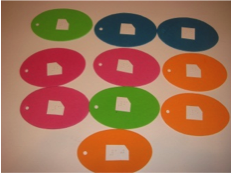
- Egg Hunt (Numbers): (foam ovals each with one braille number)
- Little Ducklings poem – unknown author
- Peck Peck Peck poem by Aileen Fisher;
- Waddle like a duck:
- After learning about duck facts (including the webbed feet and how a duck walks), teach student to waddle like a duck. Again, describe the physical waddle, why the duck waddles, and demonstrate the duck waddle. Teach the student to “waddle like a duck” (do not bend the knees, toes out; tuck the thumbs under the armpit and flap (to make wings) and quack!
- (If possible, have student wear child-size swimming fins/flippers and have the student try to walk with them on.)
- *Modification: compare how the duck waddles with other animals and play SimonSays using animal walks (walk like an elephant, hop like a bunny, jump like a frog, fly like a bird, etc.)
- Duck, Duck, Goose!
- Have the students sit in a circle facing each other. Select one student to be “it” and walk around the circle. As he walks around, he will lightly tap each child’s head and name the student a duck or goose. There can only be one goose. Once a child is called “goose” he will chase “it” around the circle. “It” must run all the way around the circle and back to goose’s original spot (and sits down) before he is tagged. If the goose does tag “it”, “it” must sit in the center of the circle. The goose becomes “it” for the next round.
- A duck’s bill is wide and flat because______( it is made to dig in mud for plants and insects).
- A duck waddles because ______ (its feet are webbed and wide apart).
- Water rolls off a duck’s back because _____ (the feathers are covered with oil).
- You can tell when an egg is spoiled because____ (when placed in a bowl of water, it floats).
- You can tell when an egg is good because ____ (when placed in a bowl of water, it sinks).
- A duck eats _____. (Grass, pond weeds, water snails and insects)
- Ruby in Her Own Time Vocabulary Game: Create your own version on an iPad or accessible tablet. Students can use dictation or audio memos to answer the questions.
- Journal prompt – Ruby, in her own time, learned to swim and fly. Tell/write about something that you learned to do, in YOUR own time
Journals can be completed using dictation or audio memos to answer the questions.
- Make a Duck Nest:
- Provide students with sticks, grass, leaves, twigs, pine needles, pebbles, mud/clay. Encourage students to create their own bird nest. Discuss why birds use these things (that they find in their natural environment) to keep their eggs warm. If possible, bring in a real bird’s nest for the student to explore.
- Duck Race (create your own duck race-similar to Duck Race in this kit)
- Duck Feathers
- Rotten Egg:
- Matching Eggs: variety of egg pairs (Use your own plastic Easter eggs, ceramic eggs, etc.) and/or different sizes of eggs. Or, take pairs of plastic Easter eggs and decorate them with different textures.
- Duck Waddle: Teach the student to “waddle like a duck” (do not bend the knees, toes out; tuck the thumbs under the armpit and flap (to make wings) and quack!
- Cook with Eggs: learn to crack eggs, make scrambled eggs, etc.