By Big Print Games
A word search is a good worksheet to adapt. It needs no special equipment, the task is easy to explain, and a few changes to the page decide whether a student can use it. This article covers the changes that matter most: how many words to include, how big the letters are, what the grid does with direction, and how to check a printable yourself before you hand it out.
Big Print Games publishes free word searches with a variety of topics that can be used online or printed.
Start with fewer words and a roomier grid
A standard word search hides about a dozen words in a 12 by 12 grid. For a beginning reader, that gives too many targets and too many small squares. Two changes help.
First, cut the word list. Eight words is a list a student can finish in one sitting, and a short list is easy to keep track of with a finger or a tick box.
Second, use fewer squares. A 10 by 10 grid has 10 letters across instead of 12, so on the same paper each square is larger, and the letters can be larger too. This is a trade. Bigger letters mean fewer of them on the page, so a puzzle has to lose squares to gain size.
Keep every word on one line of travel
Backwards and diagonal words ask the reader to switch direction mid-search. For a beginning reader, take them out. A grid where every word runs left to right or straight down gives one rule to remember: you are looking the right way if you read across or down.
Check the letter size with a ruler
“Large print” is not a regulated term. Anyone can set a puzzle in 12 point and call it large print, so measure the sheet you plan to use. The National Library Service for the Blind and Print Disabled says large print is most commonly 16 to 18 point type. The Royal National Institute of Blind People gives the same range and calls anything bigger giant print. Neither body endorses any puzzle site, and this article does not suggest otherwise.
To measure a printed page:
- Print at 100 percent, not “fit to page”. Scaling a Letter file onto A4 paper, or
the reverse, shrinks every letter by about 6 percent. - Pick a flat-topped capital such as E, F, H, I, L or T. Round letters such as O
and S are cut slightly taller on purpose. - Measure its height in millimetres with a ruler.
- Multiply by 4. The result is roughly the point size, give or take 10 percent.
By this rule, 3 mm is about 12 point, 4 mm is about 16 point, and 5 mm is about
20 point. The multiplier works because a point is 1/72 inch and capitals in most
text typefaces are about 0.7 of the type size.
Check the word list as well as the grid. A list set smaller than the letters is a
common weak point, because the student reads it at arm’s length, then looks
back at the grid.
Look at contrast and typeface
Black type on white paper, with a heavy weight and a plain sans serif face, is the safest base. Avoid grey grid lines, tinted backgrounds and decorative fonts.
An example sheet
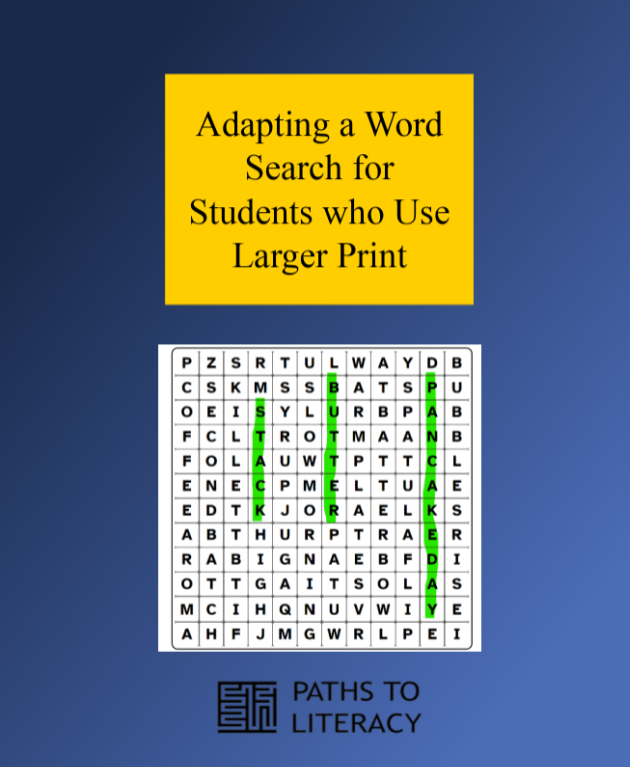
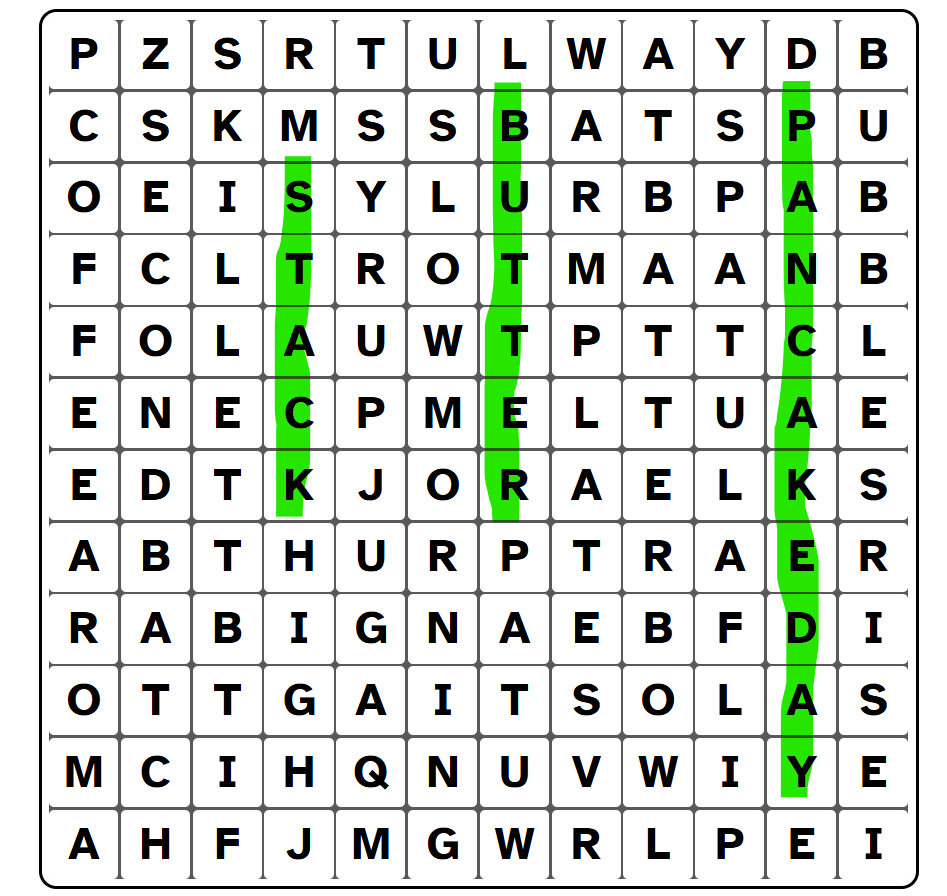
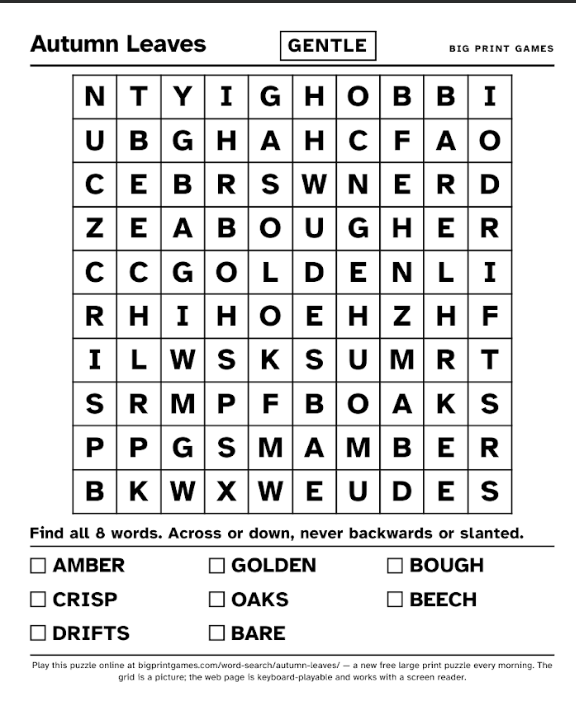
The image attached to this article is a one-page “gentle” puzzle from Big Print Games. It has 8 words on a 10 by 10 grid, every word runs across or down, the grid letters print at 31.3 point and the word list at 22 point, with a tick box beside each word. A second page carries the answer key, so a teacher or aide can check a finished sheet quickly. The same puzzle comes in US Letter and A4.
A mixed class
A single puzzle can serve two students who need different formats. One student works on the printed sheet. Another plays the same puzzle on screen, where letter size is adjustable and a high-contrast mode is available. The on-screen version is keyboard-playable and announces found words to a screen reader. The printed PDF is not a screen reader format, because its grid is an image, so a student who uses a screen reader should use the web page.
Both students look for the same eight words, so they can compare results at the end without either one working on a lesser version of the task.
Printing a set
A teacher can print a stack of puzzles, one per session, and keep the answer keys separate. Photocopying printed sheets for a class is fine. Each sheet is one page, so a student with a magnifier or a lamp has a single surface to manage.
A free source
Big Print Games publishes a free word search every day and a gentle puzzle every Monday. The gentle puzzles use the 8-word, 10 by 10, across-and-down format described above. They are on the free printable easy word searches page, with no account needed and nothing to install. Whatever source you use, run the ruler test on it first. A printable that passes the test is worth keeping, and one that does not is easy to spot once you have measured.