Piglet noticed that even though he had a Very Small Heart, it could hold a rather large amount of Gratitude.” A. A. Milne
As educators, we all know how quickly November sneaks up on us and with it, the wonderful tradition of elementary classroom crafts celebrating gratitude and the harvest season. However, as we navigate this school year, many of us are feeling the pinch of rising costs and tighter budgets. When funds are restricted and specialized material requests go unfilled, it can be easy to worry that our students will miss out on the engaging, joyful activities they look forward to.
A lack of funds does not mean a lack of fun or meaningful learning. In fact, some of my most creative and memorable classroom moments happen when I step back, look closely at what I already have on hand, and embrace the art of resourcefulness. Instead of ordering costly pre- packaged kits or rushing out to buy supplies, I have found that taking inventory of my existing craft supplies – digging through the bins of scrap paper, leftover felt, yarn remnants, and assorted tactile materials…it opens up an entirely new avenue of problem-solving and authentic creativity.
Once I gathered everything I had on hand, my next challenge was figuring out how to combine those stray items into an engaging lesson – so I turned to technology for a little brainstorming help. By turning supply-closet/bins foraging into part of the process, I not only model valuable life skills and environmental stewardship for our elementary students, but I also ensure that every child can fully participate in meaningful, hands-on holiday traditions without financial barriers holding them back. I started with the materials I found. Not one thing came to my mind. So, I typed in what I had and asked ChatGPT to “Miniature fall leaves for use in a craft for Thanksgiving or fall…No tree possibly using turkey stickers.
Need ideas?” I got a nice list of ideas which I copied into a document for you.
The book for this month is Taylor the Thankful Turkey: A children’s book about being thankful by Sonica Ellis. A sweet story where the reader follows Taylor as he visits his neighbors and the effect it has on the town. The book description: “In this heartwarming story, Taylor teaches kids the true meaning of thankfulness – it’s not just about appreciating what you have but also expressing gratitude towards others. By embracing this valuable lesson, children will boost their self-esteem, gain confidence, and radiate positivity.”
The skills worked on this month are many. Here’s but a few:
- book knowledge (i.e., title, author, page turning, image walking)
- use of low vision tools while reading the book
- develop hand and eye coordination
- turning pages
- soliciting assistance appropriately
- fine motor
- communication
- positional concepts
- choice making
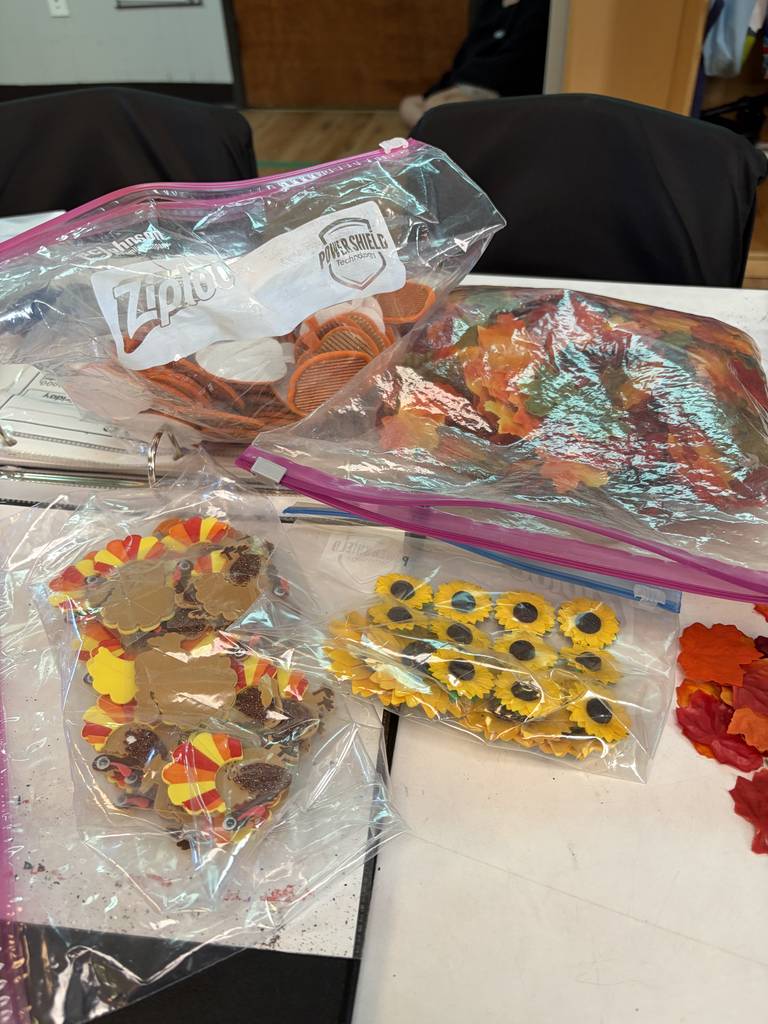
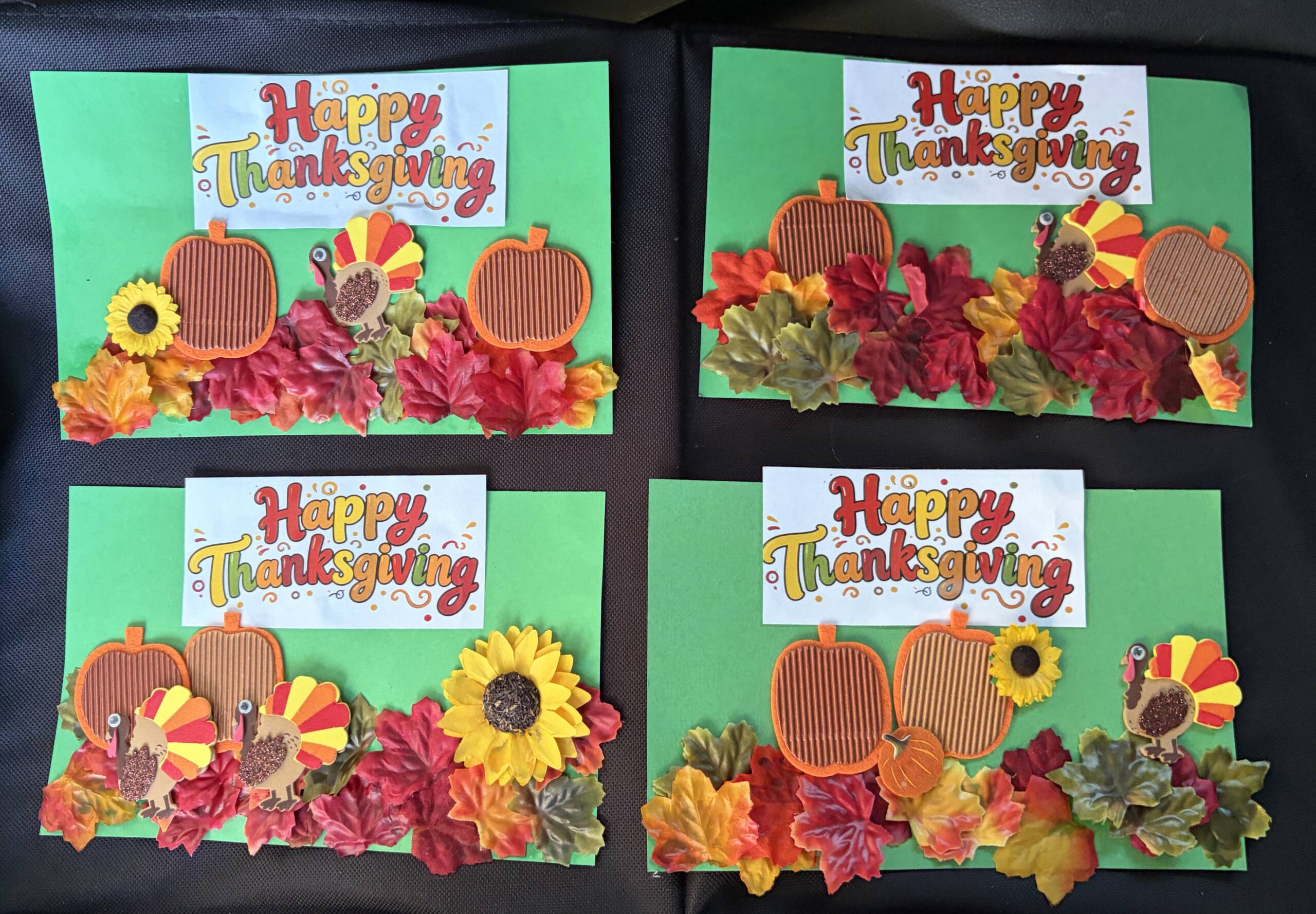
Activity one: Fall scene
Items needed for the craft:
- Green cardstock
- 3.1inch Artificial Maple Leaves 6 Colors Fall Leaves Thanksgiving
- Day Autumn Leaf
- Thanksgiving Turkeys Felt Stickers
- Felt Pumpkin Stickers Autumn Decorations Crafts
- Thanksgiving message
- Elmer’s liquid glue
- Stick glue
- Marker/pencil or name stamp
- Disposable gloves – size small
- Paper towels
- Wipes to clean the table
Keep in mind that I already had these items in my crafting tubs in the garage, including the cardstock. I looked for items that matched as closely to what I used. Setting up the work environment required my students to assist. They had to open the different bags (leaves, turkeys, pumpkins, sunflowers) to obtain the items that they wanted to use for their craft. Before they started the work, they either wrote their name or used their name stamp on the back of the green cardstock. Several of my students are working on IEP goals of squeezing a bottle of glue, working left to right/top to bottom, opening/closing containers/bags, and cleaning up their work area. For this craft, I had my students use both liquid glue (to secure the leaves) and stick glue to secure the Thanksgiving message on the top.
Activity two: Fall image
Items needed for the craft:
- Off-white card stock cut into large circles
- Stick glue
- Marker/pencil or name stamp
- Fall scene images printed on cardstock or fall themed stickers
- Wipes to clean the table
Dollar Tree had these amazing circular fall décors that students could make their own designs. They came in a set of six. One had a farm scene and the other more animals. I tried to locate them on their website, but they’re not listed. If you have fall stickers or even a CricutMaker you can make your own fall décor.
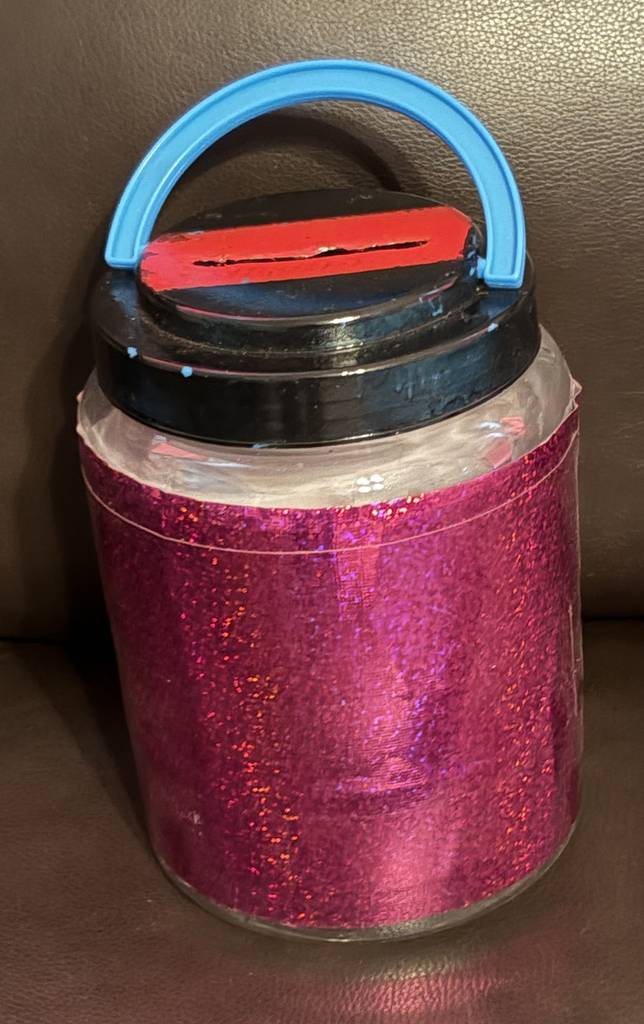
Several of my students are working on IEP goals of using both hands together (bilateral coordination), working left to right/top to bottom, soliciting assistance appropriately, and cleaning up their work area. One wonderful way we incorporate both clean-up routines and extra skill practice is by using desktop trash cans made from repurposed items like old coffee cans or plastic containers. An occupational therapist I work with taught me to wrap the outside in duct tape to add high-contrast visual cues and cover any original container markings. Then, using a Dremel tool to create a narrow slit in the lid transforms the container into an exceptional OT tool. Dropping scraps through the slit allows students fantastic practice with bilateral hand coordination, finger isolation, in-hand manipulation, and eye- hand coordination. (If a student is not yet ready for the slit, you can simply leave the lid off).
At the end of the day, crafts in the classroom are never really about expensive kits or store bought perfection. They are about connection, creativity, and shared joy. Watching my young students problem-solve with whatever materials we have on hand, collaborate seamlessly with our OT and speech therapists, and take pride in their finished work reminds me why resourcefulness is such a powerful teaching tool. When we let go of the pressure of a big budget, we open the door to authentic learning, environmental stewardship, and meaningful lessons that every child can experience together.
Here are the comprehension questions I used for this story
Before reading:
- What do you think this book will be about based on the title and cover picture?
- What do you know about turkeys?
After reading the story:
- Who is the main character of the story?
- What holiday or season is the story centered around?
- Who does Taylor show his thankfulness to throughout the neighborhood?
- How does Taylor make his neighbors feel when he shows them appreciation?
- Why do you think the author chose a turkey as the main character for a book about Thanksgiving?
- Taylor shows that gratitude is contagious. What is one specific way you can show appreciation to a classmate or teacher this week?
- If you were writing a sequel to this book called [Your Name] the Thankful [Animal], what animal would you be, and who would you thank first?
Tips
- Talk to art teachers about items they no longer need and/or to an email blast to your district colleagues about supplies they’re willing to donate.
- Crafts on Sea has a great blog post that has wonderful Fall Scene Printables
- Include OT and Speech Therapists in the lessons and/or lesson planning
- All pattern pages (from extension activities) and visual supports can be readily enlarged or adapted for low-vision devices, ensuring that students with visual impairments can fully participate in every step of the literacy and crafting process. Tactile stickers can be used for the patterns as well.
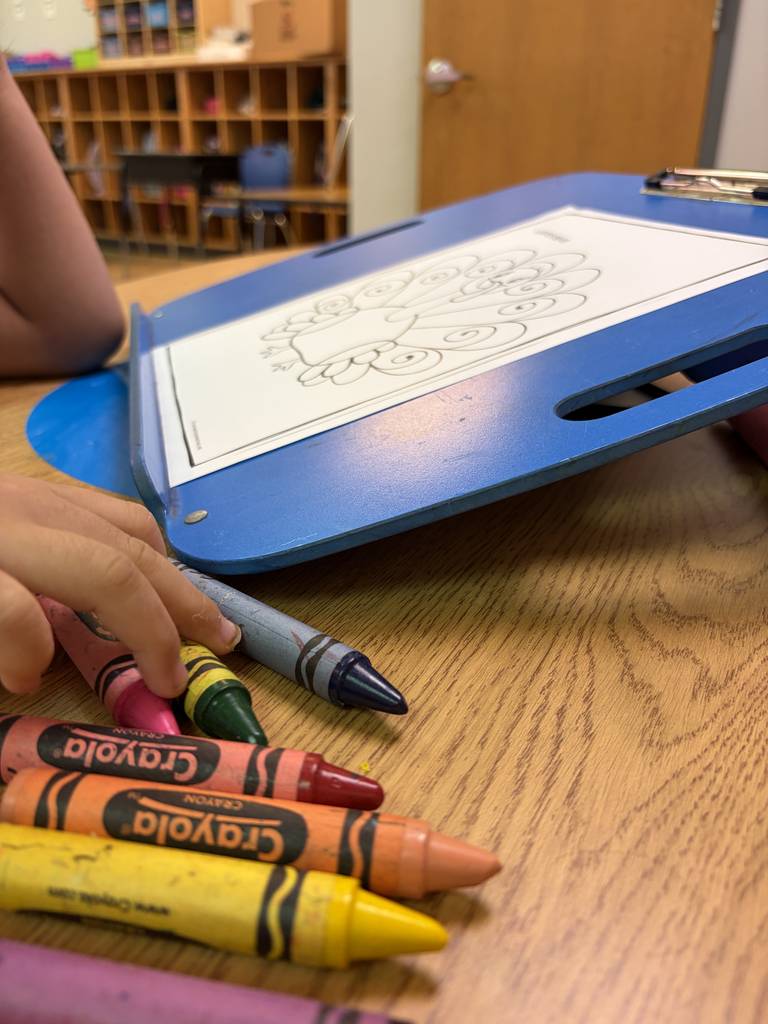
- Sometimes when I use the ReadWrite Stand, I can’t use the clip at the top as the students I’m working with can’t reach that far up. I’ve been known to use a clipboard that is secured by the clip, or I’ve secured the paper down using tape.
- Visit the clearance aisles in stores frequently. I tend to buy in bulk…basically whatever is left on the shelf within reason. This is why I have a nice supply of materials to revisit year round.
Extension activities
- Instead of copying images on colored card stock, print on white card stock and let the students color their own the colors they choose and then invite the OT to join the lesson for scissor skills.
- Homeschool Preschool has a blog post called Preschool Thanksgiving Coloring Pages for 10 free pages of color pages.
- Homeschool Preschool has another blog post called Thanksgiving Patterns Printable for 8 pages of patterns (AB, AAB, ABB, ACC, AABB, AABC, ABBC, and ABCC). Easy to enlarge or to use low vision devices with.
- Crystal and Comp has a blog post called Turkey School Bingo Printables for 7 bingo sheets and the cards to match.
- Have students write/braille/dictate gratitude notes to family, friends, or teachers.
- Start a “Craft Club” with students. I am in a life skills classroom twice a week and the other students also want to work with me. So, the teacher and I collaborated and created a craft club where we will do a joint activity once a month. We invite the OT and Speech Therapist to join us to help with individual needs and work on communication/social skills in a group setting. I am not the lead. I let the teacher be the lead, and I support the three students in the room predominately but also assist the others. It’s a lot of fun for all! October was our first trial of decorating pumpkins. All the students indicated that they wanted this to continue!