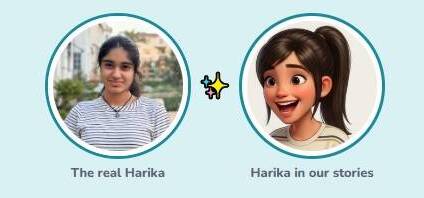
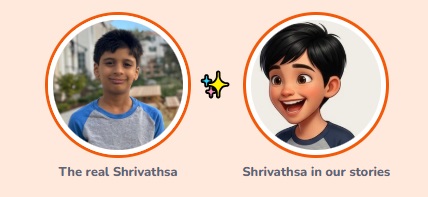
By Harika (9th grade) and Shrivathsa (3rd grade), creators of LearningJoy.net
Why we made this
LearningJoy started with my little brother Shrivathsa asking “but why?” about everything. I couldn’t answer half of his questions, so we started looking things up together and turning the answers into short science stories.
When we looked back at our own lessons, we noticed a problem. So much of the learning happened in the pictures. Color the layers of the sky. Label the parts of a cell. If you can’t see the page, you miss half the lesson. That didn’t seem fair, so we made an accessible version of every lesson we have.
It’s all at learningjoy.net/accessible. It’s free, with no ads, no accounts and no logins. There are 103 lessons (so far) for grades K to 12:
- An audio drama that my brother and I write together, starring the two of us
- A plain-text version of the story online, with sound effects and picture descriptions written in brackets
- Word files for the script, a tactile activity and a quiz, which work with screen readers, Braille displays and embossers
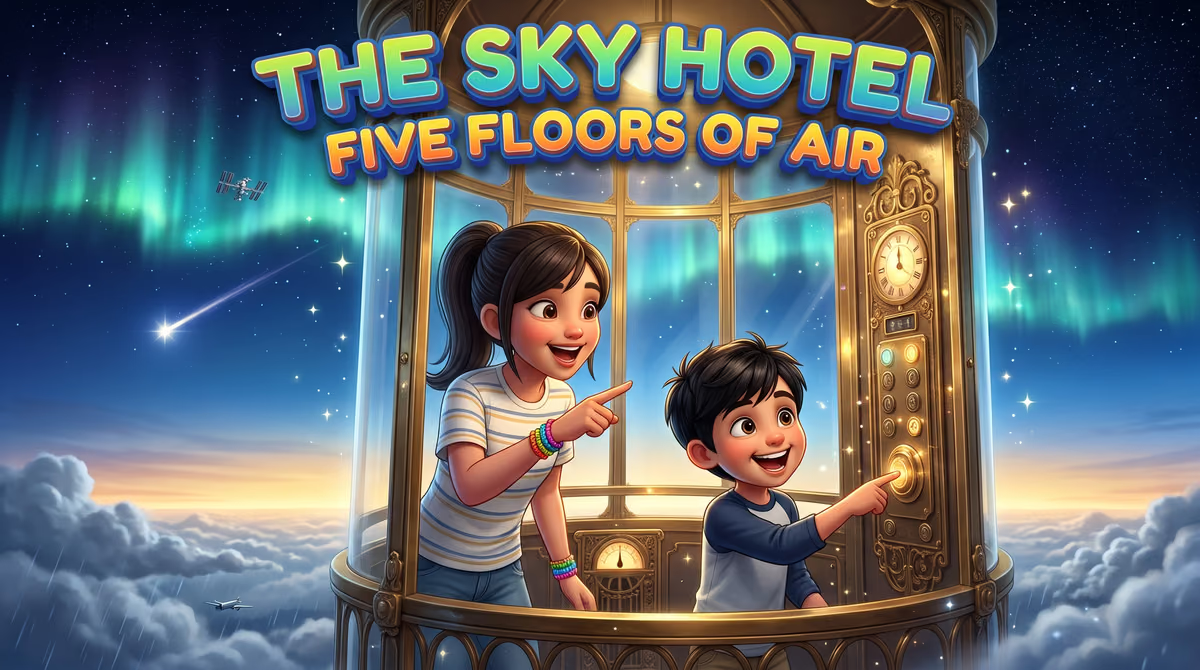
Here’s one of our favorites to try in class: The Sky Hotel, Step 1 of our Climate Changemakers path. It pairs an 8-minute audio story with a tactile model made from toilet paper, dried beans and a few things from your desk, so students can feel how the air changes as you go up.
Grade level and standards
- Grades: 3–5. For grades 6–12, the very next lesson, The Zig-Zag Sky, covers the same layers in more depth. Grades: 3–5. For grades 6–12.
- NGSS: 5-ESS2-1 (Earth’s systems). The Zig-Zag Sky adds MS-PS3-4, MS-PS1-4 and HS-PS4-4.
What you need (per student or pair)
- A computer, tablet or phone to play the audio story at learningjoy.net/accessible
- The plain-text story or the Word script, if students want to read the parts out loud
- A strip of 5 connected toilet paper squares (or 5 index cards) for the five floors
- 5 objects that feel different: a cotton ball, a plastic bottle cap, a small pebble, a crumpled ball of foil and a coin
- A handful of dried beans
- A flat square of foil for the medal at the end
Part 1: Listen, or read it as a play (10 minutes)
Press Play on The Sky Hotel right on the page, or download the MP3 (6.9 MB). In the story, my brother and I ride a giant imaginary elevator up through the five layers of Earth’s atmosphere. Elevator dings, thunder and what we describe outside the window help listeners picture each floor.
You can also read it as a play. Open the plain-text story or download the Word script. Every line starts with the speaker’s name, and the sound effects and picture descriptions are in brackets, like [Sound: Elevator DING]. So students using JAWS, NVDA, VoiceOver or a Braille display can take a lead part, not just follow along.
Part 2: Build the Sky Hotel (15 minutes)
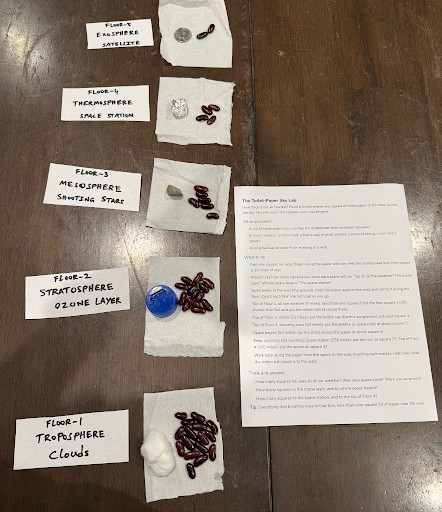
Instead of coloring a diagram, students lay the strip of 5 toilet paper squares on the desk, going away from them. The square closest to them is Floor 1, and the farthest is Floor 5.
Put one object on each floor:
- Floor 1, troposphere: a soft cotton ball for clouds and weather
- Floor 2, stratosphere: a smooth bottle cap for the ozone layer, Earth’s sunglasses
- Floor 3, mesosphere: a hard pebble for shooting stars
- Floor 4, thermosphere: a crinkly foil ball for the space station
- Floor 5, exosphere: a flat coin for a satellite at the edge of space
Feel the air thin out. Air is thickest near the ground. Students pile lots of beans on Floor 1, fewer on Floor 2, just a few on Floors 3 and 4, and only one or two on Floor 5.
Ride the elevator. Students walk their fingers from Floor 1 up to Floor 5, touching each object and feeling the beans get fewer. On the way, they say the silly sentence from the story that helps them remember the order: “The Smart Man Takes Elevator!” (troposphere, stratosphere, mesosphere, thermosphere, exosphere).
Part 3: Earn a medal, take the quiz (10 minutes)
Sky Hotel Elevator Operator Badge. Each student says or writes one big “Why?” or “How?” question about the sky. Then they make a medal they can feel. Put the foil square on something soft, like a folded towel. Press the Floor 5 coin (or the Floor 2 bottle cap) firmly into it, rub around the edge, then turn the foil over. The raised circle is theirs to keep.
Quiz. The student quiz is a Word file on the lesson card. Teachers can get the answer key through a one-minute form, which helps us see how many classrooms use each lesson.
Older students can go straight to The Zig-Zag Sky to find out why the temperature flips from cold to hot and back through the layers. Our high school lessons go further. In Cells Gone Rogue, students use the “Rule of 10” to work out how one rogue cell doubling 30 times becomes a billion cells.
All 103 lessons (and growing)
Every lesson is grouped into one of 16 learning paths across grades K–12, and each lesson heading starts with its step number, like “Step 1 of 7”, so screen reader users can jump from heading to heading.
- Grades K–2: Little Nature Detectives; Little Earth Explorers; My Body, Inside and Out; and Pushes, Pulls & Power-Ups
- Grades 3–5: Matter Detectives; Earth & Space Detectives; Energy Detectives; Climate Changemakers (grades 3–12); Nature Detectives; My Amazing Cells; Sound Detectives; and Map Makers
- Grades 6–8 (spanning 6–12): Life’s Machinery; Inside the Atom; and Earth & Space
- Grades 9–12: How Plants Work
- More Lessons (all grades): sound and voice AI, gravity coasters, the age of the universe, and more
If you try The Sky Hotel with your students, we’d really love to hear what worked and what didn’t. You can reach us at contactlearningjoy@gmail.com.
Note: Images created with AI. Paths to Literacy does not sell resources or materials. Information about third party providers, products, and services does not constitute an endorsement or recommendation by Perkins School for the Blind or TSBVI. It is the user’s responsibility to verify and investigate providers, products, and services.