
For students with visual impairments, academic success is only one piece of the developmental/educational puzzle. To fully access the world, these students require specialized instruction known as the Expanded Core Curriculum (ECC). The ECC encompasses nine essential areas—ranging from independent living skills to assistive technology—that sighted peers often learn implicitly through observation (Allman et al., 2014).
Because a large portion of ECC skill development happens outside the classroom, collaboration with families is VITAL! One of the most effective tools for bridging the gap between home and school is having an ECC parent questionnaire. By leveraging resources from the Texas School for the Blind and Visually Impaired (TSBVI) and the American Foundation for the Blind (AFB), Teachers of Students with Visual Impairments (TVIs) can design comprehensive questionnaires that turn parents into active educational partners.
In Texas, Senate Bill 39 passed by the 83rd Texas Legislature became effective on September 1, 2013. This Senate Bill mandated mandatory ECC evaluations and instruction. Based on the ECC assessment data, the ARD (Admission, Review, Dismissal) committee must document and
develop targeted annual goals and instructional strategies to meet the student’s unique visual and functional needs.
In the past, I have had phone conversations or emails to reach out to the parents. This summer I created different surveys to send to the families or as a guide when I talk with them to, I prefer to use surveys to assist in our evaluations we do initially as well at the review which is every 3 years. There is a vast variety of topics in the ECC to cover and adjusts at each grade level. The surveys help adjust and narrow these topics to more age-appropriate activities in the discussion. We have ARD/IEP (Individual Education Plan) meetings yearly where we write the student’s Present Levels of Academic Achievement and Functional Performance (PLAAFP)
to show a ‘snapshot’ of the student’s current abilities and where the gaps exist. I broke the surveys into age level groupings: ECI (Early Childhood Intervention), Elementary age, Middle School age, High School age, and the 18+ Program age.
Grounding the questionnaire in key resources
To create a valid and user-friendly questionnaire, we do not need to reinvent the wheel. It’s already been written for us. I had started researching information online and I used the following two foundational texts provide my framework.
The TSBVI ECC flyer
The Texas School for the Blind and Visually Impaired (TSBVI) provides an accessible, family-friendly “ECC Flyer” that breaks down the nine areas of the curriculum into understandable digestible concepts (TSBVI, n.d.). This flyer is an excellent tool for defining vocabulary before asking parents to evaluate their child’s skills. For instance, instead of asking a parent to score
their child on “Compensatory Skills,” the flyer helps reframe the concept around concept development and communication modes.
ECC essentials (AFB Press)
Published by the American Foundation for the Blind (AFB), ECC Essentials: Teaching the Expanded Core Curriculum to Students with Visual Impairments is the gold standard for structuring ECC assessments. Edited by Carol B. Allman, Sandra Lewis, and Susan J. Spungin (2014), this text emphasizes that assessment must be ongoing and collaborative. It provides sequential milestones for each of the nine ECC areas, giving educators concrete benchmarks to translate into parent-friendly questions. This book also has AMAZING ideas of activities to try.
Step-by-Step Guide to Crafting the Questionnaire
When I was designing an ECC questionnaire for families, my goal was to balance thoroughness without using all the educational jargon we tend to use. I want the parent as an equal partner and not for them to be overwhelmed.
The first thing I tried to do in the surveys was to demystify the nine areas for the parents of my students. Parents cannot accurately report on skills they do not understand. Communication is key! So, I decided to begin the questionnaire with a brief, affirming introduction based on the TSBVI ECC Flyer as well as a brief blurb for each of the nine areas.
I then worked on translating that professional jargon into typical daily routines. I had to edit my surveys numerous times to a void clinical or educational terminology or what I call “robot questions.” I used the benchmarks found in ECC Essentials to turn abstract skills into concrete,
observable household tasks. Instead of my asking, “How are your child’s Independent Living Skills progressing?”, I chose to ask:
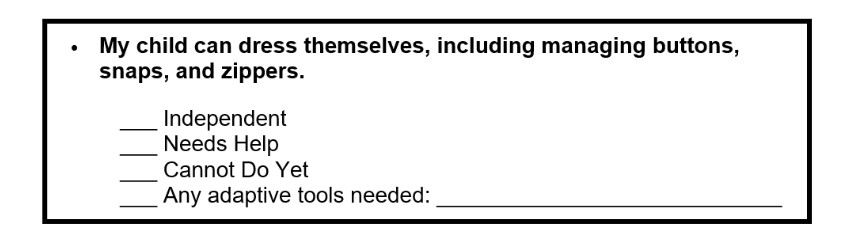
This is an example from the elementary survey I wrote. After talking to a couple of the parents I work with, they preferred this set up. Following each of the nine areas is a space for the parents to elaborate if they want to. If they don’t, then that provides me an opportunity to reach out and start a dialogue on the topic with them.
I used different response scales based on the student’s grade level and the examples I used. I wanted to honor the parents’ time by keeping the scale as easy to understand as possible. I used different scales to help provide clearer data for the IEP team. I did include several open-ended questions with the focus being on the future at the end of each of the surveys. My objective was to identify the family’s long-term vision for their child, while remaining mindful that these expectations adapt and change as the student progress through each
grade level. These questions look different at each of the grade level surveys. I did this so that parents to share their vision for their child. I won’t lie, I wanted to develop and cultivate a collaborative approach when working with the parents/families of my students. In my opinion, an ECC parent questionnaire should never be treated as a passive data collection chore. My goal was when a I send home a questionnaire aligned with TSBVI and AFB standards this school year, I am sending a message that the family’s insight is invaluable and that I hear them.
Once completed, my plan is to use the data gathered to directly influence the student’s (PLAAFP) statements and assist in shaping meaningful, real- world IEP goals. Keep in mind, this is NOT the only tool I use. I listen to my student’s desires and the other educational team members (teachers, therapists, etc.). I am hoping that by using the questionnaire that I spent the summer researching literature and everyday home routines, I can ensure that the student’s team is unified, moving together toward the ultimate goal of independence.
References
Allman, C. B., Lewis, S., & Spungin, S. J. (Eds.). (2014). ECC essentials: Teaching the expanded core curriculum to students with visual impairments. AFB Press.
School for the Blind and Visually Impaired. (n.d.). The expandedcore curriculum (ECC) flyer. https://www.tsbvi.edu/
Expanded Core Curriculum (ECC) Parent Questionnaire
Infant and Toddler Developmental Intake